In this Article
- The Journey from Harness Racing to Pleasure Riding
- The Volunteers Behind the Re-homing Process
- Patience in the Saddle: Retraining the Standardbred
- Real-World Impact: Thriving in New Jersey
- Continuing the Legacy of the Standardbred
The Journey from Harness Racing to Pleasure Riding
Retirement from harness racing typically occurs in the range of 36 to 48 months of age. This early end to a track career leaves these young athletes with somewhere around 20 to 25 years of post-track life as riding companions. The mission of adoption & transition programs is helping horses move from a highly regimented racing life into a relaxed, versatile pleasure career.
The intake committee evaluates track retirees by prioritizing mental burnout indicators over minor physical wear, deciding that a sound mind is the primary prerequisite for a successful pleasure riding transition. A horse that remains curious and willing, even with minor joint changes, proves far easier to retrain than a physically pristine animal suffering from severe track anxiety.
Key points:
- Evaluation Focus: Mental soundness outweighs minor physical wear during intake.
- Lifespan Potential: Retirees have over two decades of life remaining for new disciplines.
- Core Objective: Transforming regimented track athletes into relaxed pleasure mounts.
The Volunteers Behind the Re-homing Process
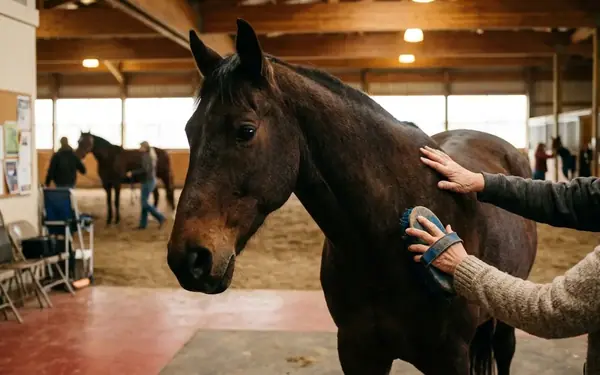
The daily routines of the volunteers who dedicate their time to rehabilitating these athletes are central to the transition process. Morning groundwork and feeding routines often run from approximately 6:00 AM to 8:30 AM to mimic track consistency. This structured schedule provides a familiar anchor for horses stepping into an entirely new world of equine care.
Coordinators pair volunteers with specific horses based on handling experience and the horse's track history. Initially, the program tried rotating volunteers daily to desensitize the horses, but this disrupted the animals' need for routine and stalled their progress. Recognizing the error, the approach shifted. Dedicated one-on-one pairing now lasts for the first 45 days of rehabilitation, allowing a deep, trusting bond to form.
"The moment a former pacer softens to a gentle half-halt and drops their head, you realize the track mentality is finally melting away. They look to you for guidance instead of waiting for the starting gate."
This intensive rehabilitation framework relies on a partnership sustained across multiple grant periods with local New Jersey equine facilities. These established locations provide the safe, enclosed environments necessary for early groundwork, keeping the horses secure as they learn a completely new vocabulary of human interaction.
Patience in the Saddle: Retraining the Standardbred
Transitioning a horse from driving cues to riding cues requires a fundamental shift in communication. Trainers deliberately delay the introduction of leg pressure, deciding instead to rely heavily on the voice commands the horses already learned while driving, gradually mapping those vocal cues to seat aids. Groundwork and lunging phases span an estimated 90 to 120 days before introducing a rider's weight.
The transition timeline varies heavily based on whether the horse was raced in hopples or free-legged. Free-legged trotters often find their under-saddle balance faster, while those accustomed to the mechanical support of hopples need extensive time to discover their natural rhythm. While many Standardbreds naturally adapt to a riding trot, those with deeply ingrained pacing instincts require specialized cavaletti groundwork over several months to find their trotting balance, meaning they cannot be rushed into immediate under-saddle work.
A horse rushed into canter work before developing proper pelvic flexibility often reverts to a lateral pace under stress. Building that flexibility takes deliberate, unhurried repetition.
Training recommendation:
Focus early training entirely on groundwork exercises that build trust and lateral flexibility. Incorporate wide serpentines and low ground poles at a walk before asking for any complex under-saddle transitions. This builds the necessary core strength for carrying a rider.
Real-World Impact: Thriving in New Jersey
The placement team mandates a multi-step matching protocol, deciding that adopters must demonstrate compatibility through supervised interactions rather than simply selecting a horse based on physical appearance. Adopters must complete a minimum of 3 supervised riding sessions prior to finalizing the placement. This ensures the rider's skill level matches the horse's current stage of retraining.
Once placed, these horses excel across the state in diverse disciplines. Former track stars now navigate dense wooded trails, execute low-level dressage tests, and participate in competitive driving events & shows. A mandatory 6-month post-adoption follow-up period ensures the horse is acclimating to its new discipline and provides a safety net for both horse and rider.
"I expected a hot-blooded ex-racer, but I got a willing partner who approaches every new trail obstacle with curiosity rather than fear. His work ethic is unmatched."
This ongoing support network, bolstered by active member programs, reinforces the community aspect of the organization. Adopters frequently share training milestones and seek advice, creating a collaborative environment that helps ensure no one navigates the retraining journey alone.
Continuing the Legacy of the Standardbred
The broader impact of volunteering extends deep into the local equestrian community, demonstrating the viability of these breed resources to riders who might otherwise overlook an ex-harness racer. Want to join us in making these transitions possible? Local barns are always seeking patient hands to assist with morning routines and groundwork.
Drawing on historical registries maintained by the United States Trotting Association, educational outreach coordinators chose to center their community messaging around the Hambletonian 10 lineage, deliberately reframing the breed's public perception from high-strung track athletes to cooperative partners. Nearly all modern Standardbreds trace their lineage back to the founding sire Hambletonian 10, a horse historically documented for passing on a remarkably docile and willing temperament, proving these ex-racers are genetically predisposed to be cooperative partners rather than high-strung athletes.