In this Article
- The Sport Horse Redefined
- Navigating the Upcoming Show Schedule
- Training Timelines and Ring Readiness
- The Call to the Post
The Sport Horse Redefined
Standardbreds are not merely 'slowing down' for retirement—they are elite, naturally gifted sport horses actively dominating the pleasure ring with unmatched stamina and trainability. Compared to traditional warmbloods, the Standardbred brings a proven work ethic forged in highly demanding environments. They enter the show ring with a mind built to process pressure, making them exceptionally reliable partners for both flatwork and pattern classes.
Drawing on a review of event planning logs from the past three seasons, the show committee initially considered grouping all transitioning racehorses into a single 'green' division. They rejected this approach in favor of separating them by specific gait capabilities. This structural decision honors the breed's distinct biomechanics and allows both trotters and pacers to compete on fair footing, showcasing their natural movement without artificial constraints.
Upcoming Show Season Essentials
- Verify the horse's freeze brand documentation or certified registration papers through the United States Trotting Association.
- Submit class entry forms in the range of 14 to 18 days before the event.
- Confirm eligibility for specific novice or open divisions.
- Prepare current Coggins and health certificates.
Navigating the Upcoming Show Schedule
The SPHO-NJ show schedule offers a diverse range of classes tailored to highlight the breed's versatility. Competitors can expect robust divisions in English Pleasure, Western Pleasure, and in-hand conformation. Each category demands a distinct presentation style, yet all share a foundational requirement for obedience, rhythm, and relaxation.
In-hand conformation classes require horses to stand square for approximately 45 to 60 seconds while the judge assesses optimal structural balance. This stationary discipline tests the handler's ability to present the horse's conformation without the masking effect of forward motion. Handlers must practice establishing this square halt promptly and maintaining the horse's focus throughout the inspection.
Under saddle, the evaluation criteria shift toward cadence and willingness. Judges adjust their scoring to prioritize a relaxed, four-beat walk and a rhythmic trot or pace, deliberately shifting focus away from the high-knee action typical of saddle seat breeds to reward natural movement. A transitioning racehorse that demonstrates a quiet mouth and steady tempo will consistently outscore a tense horse exhibiting flashier, artificial gaits.
The SPHO-NJ structures these events to support both novice handlers and experienced equestrians. Shows are designed to be educational rather than purely cutthroat. Ring stewards actively assist newcomers with class protocols, ensuring the transition from the racing circuit to the show ring remains a positive, constructive experience for both horse and rider.
Training Timelines and Ring Readiness
Preparing a former harness horse for the pleasure ring requires a systematic approach to physical and mental conditioning. Transitioning a horse's musculature from linear track speed to collected ring work typically requires somewhere around 90 to 120 days of dedicated retraining. One catch: this timeline assumes the horse has been let down from track conditioning for an estimated three months or more; horses coming straight off the sulky will require an extended period of turnout before beginning ring work.
Risk Factor: Rushing the transition from track to ring often results in a hollow back and inverted frame during the trot.
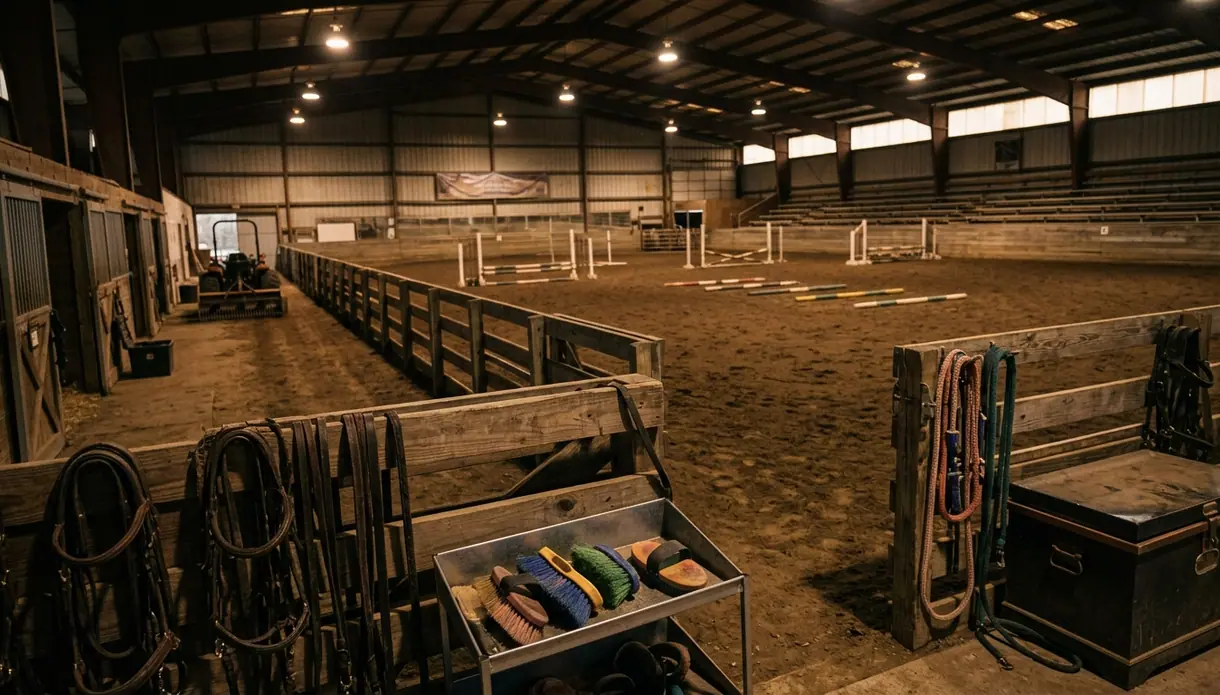
To build the necessary strength for collected work, trainers systematically introduce ring boundaries by setting up temporary dressage letters and ground poles, gradually tightening the work space to encourage the horse to balance its track-built hindquarters. This spatial restriction teaches the horse to carry its weight backward and lift through the shoulders, rather than leaning on the forehand as it might have done in the harness.
Mental preparation is equally critical to ring readiness. The degree of desensitization required varies heavily depending on whether the horse previously raced at large, noisy tracks or smaller, quieter county fairs. A horse accustomed to the roar of a grandstand might ignore a crackling PA system but spook at a cluster of umbrellas near the rail.
Recommendation: Replicate show-day stimuli at home. Play recorded crowd noise through portable speakers during flatwork sessions and invite other riders to share the ring to simulate a crowded warm-up ring.
The Call to the Post
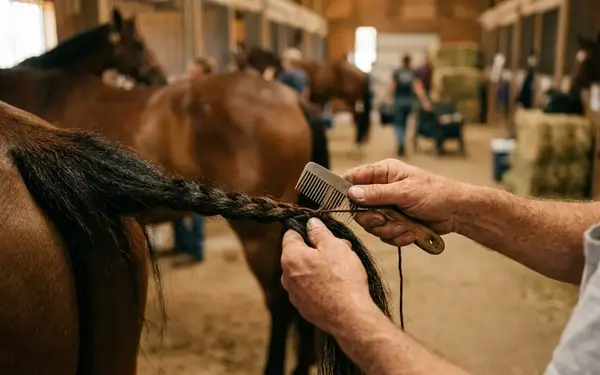
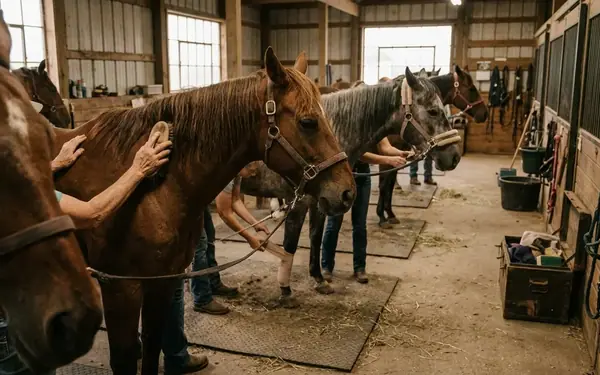
Success in the pleasure ring culminates in the final moments before the class begins. Handlers time their warm-up routines to conclude an estimated three to five horses before their class, ensuring the horse remains attentive but not fatigued while waiting at the in-gate. A final wipe-down with a damp towel is typically applied somewhere around 60 to 90 seconds before entering the ring to remove ring dust and maintain a gleaming coat.
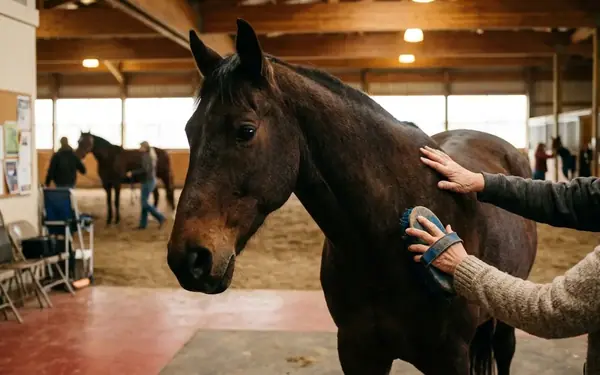
A former pacer stands calmly at the in-gate on a crisp New Jersey morning. The gelding's dark bay coat catches the early sun, his mane perfectly braided against a strong, muscular neck. He watches the horses circling inside the ring, entirely focused, waiting with pricked ears for the judge's call to enter the ring.