What Your Horse's Neck Symbols Immediately Reveal
Misreading a single character on a blurred neck brand leaves a horse's medical history, behavioral quirks, and pedigree locked away. An accurate read instantly reveals their registered identity, exact age, and eligibility for pleasure horse programs.
The identification system relies on a five-character mark stamped onto the right side of the neck. The first symbol is a letter of the alphabet that denotes the birth year, followed by four right-angle or alphanumeric characters that translate into a unique registration number. Together, these five marks serve as a permanent key to official breed resources, linking the horse in your barn aisle to its complete historical file.
Breeders and racing registries moved away from liquid-nitrogen neck irons after evaluating how often shifting foals caused smudged right-angle characters. Beginning with the 2019 foal crop, the registry started phasing in ISO-compliant 134.2 kHz microchips. Physical freeze branding remained mandatory through the 2021 foaling season before becoming optional alongside implanted transponders in 2022. Because visual neck brand decoding applies strictly to horses foaled prior to 2022 or those whose breeders paid an optional fee for physical branding, younger horses without neck marks require an electronic RFID wand swept along the nuchal ligament.
Translating the Right-Angle Alphabet and Birth Year Letters
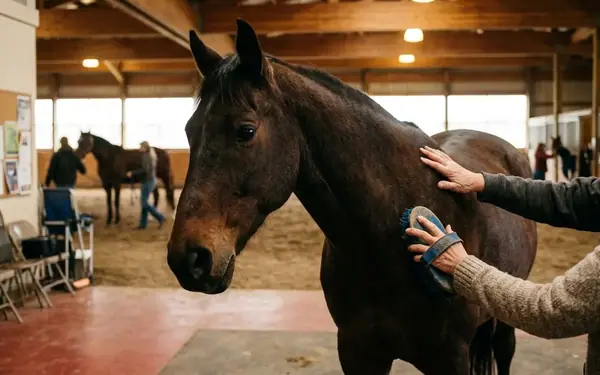
Long winter coats and sun-bleached bay or chestnut hair frequently obscure the white hairs of a freeze brand. Dry-brushing a thick coat scatters dander and blurs the white hair boundaries, hiding the crisp corners needed for an accurate translation. Saturating the crest with a wet sponge or rubbing alcohol flattens the coat and turns faint, fuzzy edges sharp against the darker skin. Photographing the dampened neck at a 45-degree angle often reveals symbol lines that look broken from straight on.
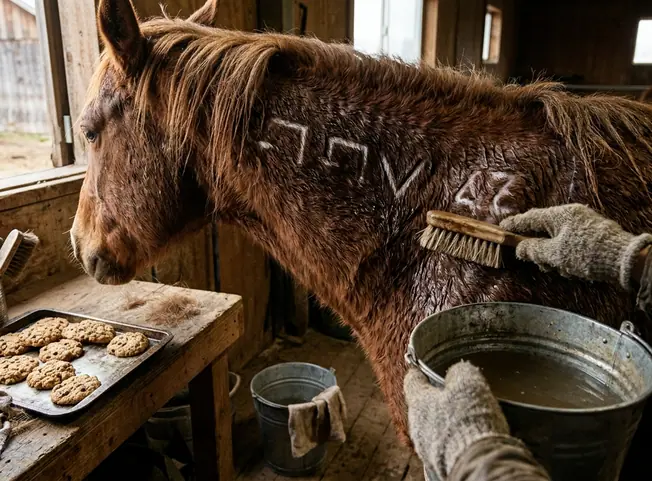
When working with gray or light-chestnut horses where white hairs blend into the base coat, clipping the brand site with a #10 or #15 blade leaves hair lengths hovering near 1.2 mm to 1.5 mm. This exposes the underlying unpigmented skin so you can trace the scar tissue directly.
Mapping the 23-Letter Birth Year Cycle
Once the hair is prepped, isolate the first character on the far left. The registry uses a 23-letter birth-year rotation that omits the letters I, O, and Q so handlers never confuse them with the numerals 1 and 0. Because this 23-letter cycle repeats every two decades, a single letter points to two possible birth years. For instance, the letter 'J' represents both the 2011 and 1990 foal crops. Owners should check incisor wear and Galvayne's groove to confirm the correct decade before running their search.
Decoding the Four Right-Angle Numerals
The four characters following the birth-year letter use a patented right-angle symbol system that converts open squares, angles, and lines into the numbers 0 through 9:
- Locate any single vertical or horizontal bars: a single vertical bar represents 1, while a horizontal bar represents 0.
- Identify two-sided right angles: depending on which way the corner points, these single angles translate to 2, 3, 4, or 7.
- Check the three-sided open boxes: a right-opening three-sided box represents 5, a left-opening box represents 6, a downward-opening box represents 8, and an upward-opening box represents 9.
- Write down two or three plausible variations if a scar, hair whorl, or neck muscle growth distorts a character's third or fourth position.
Pulling Official Lineage and Foaling Records from the USTA
With your five-character string and any backup permutations written down, open the online lookup tools provided by the United States Trotting Association (USTA). Entering the decoded five-character freeze brand into the free horse lookup tool pulls up the matching animal's public database entry—a proven lookup method for horses registered prior to the 2022 transponder transition.
When a stretched symbol forces you to test a matrix of three or four character permutations, batch queries will return several possible horses. Cross-referencing the physical markings listed on the registry readout against the horse standing in the barn aisle confirms the exact match. Official registration records categorize leg markings down to the exact anatomical joint, distinguishing between a 'coronet' (a white band just above the hoof), a 'pastern', a 'fetlock' (ankle), and a 'half-canon'. Comparing these specific hind-leg white markings alongside facial stars and snips quickly eliminates the wrong candidates.
Once you verify the profile, extract the foundational details for your equine care files. The public readout provides the horse's registered name, sire and dam lines, and the breeder's location. It also shows whether the horse actively competed or remained an unraced prospect. Even unraced horses carry a permanent five-character registration string and an electronic eligibility record if they were nominated to regional stakes as yearlings.
Reaching Out to Former Trainers, Grooms, and Breeders
A horse's official paperwork lists the legal owners at the time of racing, yet syndicate members or lessees often hold shares in dozens of horses without ever handling them in the barn. To learn who your horse was on the ground, bypass the syndicate listings and cross-reference the past performance charts to find the trainer of record who conditioned the horse for 60 or more consecutive days. Small-stable trainers, grooms, and breeders spend hours every morning with their stock and remember daily personality traits long after a horse leaves the circuit.
Timing Your Barn Outreach
Standardbred training barns typically work on morning schedules from 5:30 AM to 11:30 AM. Sending your message in the mid-afternoon between 1:00 PM and 4:00 PM gives you the most reliable window to reach trainers or caretakers after morning jogging and stall cleaning wrap up.
When making first contact with harness racing professionals, lead with respect and gratitude. Share a current photo of the horse thriving in their new New Jersey pleasure or trail home, and assure them right away that your inquiry comes purely out of appreciation for the horse they raised or conditioned. Once a warm connection is established, ask specific, practical questions that support a smooth adoption and transition process:
- Did the horse wear an overcheck bit, Murphy blind, or shadow roll on the track? Knowing this immediately explains why a retiree might carry their head high or spook at shadows on the ground under saddle.
- What were their past turnout habits, and did they prefer going out alone or with a herd?
- Did they have any old minor injuries, stall quirks, or favorite treats around the shedrow?
Using Racing History to Guide Retraining Under Saddle
A horse's past performance lines or breeder notes will tell you whether they trained as a trotter or a pacer. Reviewing this gait classification before the first saddling session helps you set realistic expectations in the riding arena and tells you whether to set ground poles at trotting intervals or pacing intervals when encouraging the horse to relax its back. Pacers move laterally, with the left fore and left hind advancing together, and they often default to a four-beat stepping pace or 'amble' on the trail. Diagonal-gaited trotters transition more directly into a traditional three-beat canter when cued from the outside corner.
Uncovering that official five-character identity also opens the door to local member programs, events, and shows. Submitting a verified registration number to the Standardbred Pleasure Horse Organization of New Jersey qualifies your horse for breed-restricted shows, trail challenges, and year-end high-point awards across trail mileage, dressage, and English or Western pleasure divisions.
Will you start tracing that history today by taking a wet sponge to your horse's neck in the barn aisle, or by sending an afternoon note to the breeder already printed on your registration papers?