Why Iron Hanover’s Pace Could Not Become a Canter Through Speed
A pace is a two-beat lateral gait: the front and hind legs on the same side move forward together. A dressage canter follows a different sequence. The outside hind strikes first, a diagonal pair follows, and the inside fore completes the three beats. For a Standardbred accustomed to pacing, the challenge is to organize those footfalls while lifting and carrying the back.
Iron Hanover made that distinction clear. When his training team initially drove him forward under saddle, hoping momentum would produce a canter, he paced faster and hollowed more. The team stopped mounted canter requests and shifted to unmounted balance work. Speed had reinforced the movement they needed to change.
The governing decision was to build the three-beat canter on the ground before asking a rider to carry it. Pole routines and lunge-line work gave Iron Hanover room to learn a new balance without rider weight altering the result. Only when he could sustain a balanced three-beat rhythm on the lunge did a ridden departure become a reasonable next request.
That approach respects what makes retired Standardbreds such valued pleasure and show horses. Their stamina and willingness offer a strong foundation for a new career. In Iron Hanover’s case, turning that foundation into a dressage canter required deliberate work on the track-ingrained pacing pattern.
Iron Hanover’s Starting Point After the Track
Free-lunge transitions exposed the problem before a rider entered the picture. When asked for more speed, Iron Hanover locked through his lumbar spine and fired his ipsilateral legs together. That same-side sequence was familiar to him; the lifting, coordinated canter departure was not. Under saddle, the pattern appeared as a hollow back and a rapid, unbalanced pace.
Retired harness racers can learn to trot and still find the canter difficult. A diagonal trot gives the horse a different two-beat option, but canter asks for a distinct sequence and enough trunk engagement to support the transition. Iron Hanover’s baseline therefore called for more than a clearer cue. His movement had to change before the cue could produce the intended gait.
The free-lunge assessment offered a useful test: watch the first few strides after a request for increased energy. If the horse lengthens through the back and organizes the limbs, the handler has a basis for further work. If the back hollows and the lateral pairs quicken, repeating the request risks rehearsing the pace. With Iron Hanover, that observation directed the team away from mounted canter work.
The scope matters. Not every Standardbred carries lateral muscle memory to the same degree. A horse that naturally settles into a diagonal trot after retirement may bypass several of Iron Hanover’s early hurdles. Track history and physical conformation also affect how long retraining takes. Those differences make the horse’s current footfalls more useful than a schedule when deciding what to ask next.
Curved Poles That Interrupt the Lateral Rhythm
The groundwork began by giving Iron Hanover a reason to place his feet more deliberately. A single ground pole on a straight line offered a simple articulation task. Once he could approach without rushing or losing his balance, the handler used poles on a curve. The curved line asked the inside hind leg to step farther beneath his center of mass, disrupting the simultaneous same-side action that sustained the pace.
Setting the curved line
The later configuration used 4 to 5 ground poles, spaced 9 to 10 feet apart on a 15-meter circle, with the outside edges raised 6 to 8 inches. That arrangement gave the horse a defined path through the exercise while asking for greater joint articulation. The handler’s job was to maintain a controlled approach and observe the footfalls, rather than send the horse through faster each time the sequence became uncertain.
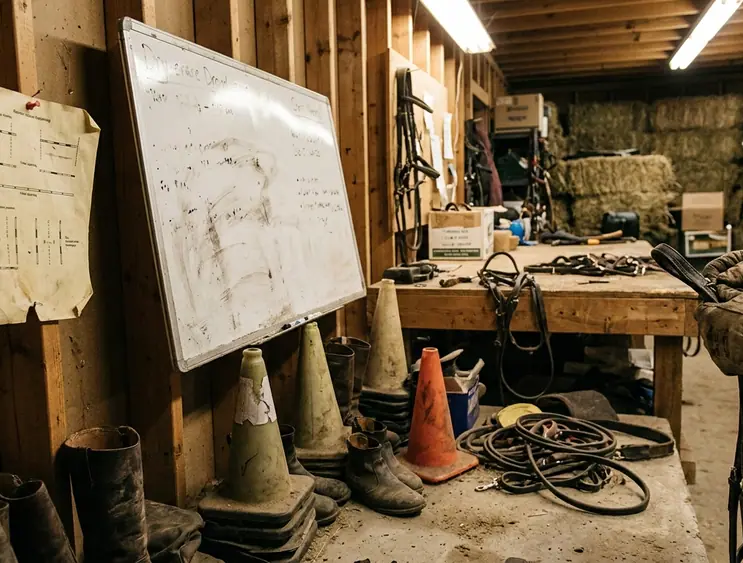
Spacing and height describe Iron Hanover’s routine, not a setting to impose on every horse. A handler introducing the exercise should first establish a relaxed diagonal trot on a 20-meter circle without poles, then use a single pole to see whether the horse can remain organized. The full curved arrangement belongs later in the progression, when the horse can negotiate the question without scrambling.
Reading the response
Curved poles created an opportunity for Iron Hanover to rock back onto his hindquarters and lift through his body. They did not, by themselves, make every stride a canter. The useful response was a horse that could separate the lateral pairs, keep his back available, and offer a clear three-beat rhythm on the lunge. A quicker pace over the poles would have left the central problem untouched.
For adopters planning their own groundwork, the progression is straightforward:
- Establish a relaxed, diagonal two-beat trot on a 20-meter circle without poles.
- Introduce a single ground pole on a straight line and watch whether the horse maintains his balance.
- Progress to Iron Hanover’s curved pole arrangement only when the simpler exercise remains calm and organized.
- Confirm a balanced three-beat canter on the lunge before beginning mounted canter requests.
Each stage answers a movement question. Advancing because the horse has repeated an exercise for a certain number of sessions offers less information than seeing a steady rhythm and a back that can lift.
Keeping Rider Weight From Reviving the Pace
Groundwork changed what Iron Hanover could offer. The rider then had to protect that balance. A slight shift of weight back, paired with a deep, following seat, kept the rider’s center of gravity from tipping onto the forehand during the corner approach. A forward-leaning torso resembled the posture associated with harness work and could prompt Iron Hanover to return to his pacing response.
The corner served as a preparation point. It helped establish bend and gave the rider a place to check whether the horse remained balanced before the departure. A measured half-halt then organized the energy so the outside hind leg could take the first canter beat. The request followed that preparation; it did not substitute for it.
Rider tension could undo the sequence quickly. Gripping through the leg or bracing in the seat restricted the back just as Iron Hanover needed to lift it. Leaning forward added another familiar signal to hurry. The rider therefore kept the aids quiet and the seat following, watching for the difference between an energetic transition and a fast lateral one.
The initial ridden goal was a maximum of 3 to 4 quality canter strides. The rider then returned quietly to a balanced trot. That short request made the standard clear: a few organized strides counted for more than a longer stretch in which the back hollowed and the footfalls slipped toward a pace. It also allowed the next departure to begin from balance rather than from the momentum of the previous attempt.
For pleasure riding and events & shows alike, this distinction shapes the finished gait. A rider can feel a back rise into the transition and support an unhurried rhythm. If the back drops away while the legs quicken laterally, the immediate task is to restore a balanced trot and prepare again.
What Counted as a Three-Beat Canter
Iron Hanover’s progress was assessed through movement, not speed. On the ground, the handler looked for a distinct three-beat footfall. Under saddle, the rider checked for the tactile change of a back lifting into the upward transition instead of hollowing. Those observations gave both people a practical way to distinguish a canter from a rapid pace.
The later picture was more settled: a relaxed jaw, an engaged core, and the ability to sustain a true three-beat rhythm on a 20-meter circle. The circle mattered because it asked Iron Hanover to keep his balance while turning. A brief canter on a straight path would have shown less about his ability to carry the gait through the sort of work expected of a dressage mount.
This change took over a year of consistent, incremental retraining. Years of practiced pacing did not disappear because Iron Hanover produced one correct departure. Repeating organized transitions, while avoiding rushed lateral ones, gave the new movement a place in his regular work.
There is a useful distinction between reaching a gait and owning it. A horse may offer three beats for a few strides yet lose the sequence as soon as the circle, rider weight, or request for more energy changes the demand. Iron Hanover’s improvement became meaningful when the footfalls, back, and balance agreed through sustained work on the circle. That is the standard worth carrying from groundwork into the show ring.
Make Ground Balance the Gate to Ridden Canter
Iron Hanover’s protocol set a firm boundary: no under-saddle canter work until he could sustain a balanced three-beat rhythm on the lunge line. Once that rhythm existed, the rider asked for short, prepared departures and returned to trot before quality deteriorated. The rule placed biomechanical readiness ahead of an arbitrary training date.
When the rider finally sits the trot and asks for that first true canter departure, the Standardbred should feel like a horse stepping up into a new frame, not one rushing to escape the pressure. If the back lifts and the outside hind strikes off cleanly, the groundwork has done its job.