From the Harness Track to the Open Hunter Ring
Morning mist still clings to the Monmouth County showgrounds warmup ring as a dark bay gelding ticks smoothly down a line toward an entry-level oxer set at 2 feet 6 inches with a 2-foot-3-inch spread. Along the right side of his crest, the crisp white U.S. Trotting Association freeze-brand—alpha-numeric symbols marking his birth year and registration number—catches the early sunlight. He folds his knees evenly, rounds across the rails in soft, rhythmic form, and lands easily on his right lead. Two rails over, a local hunter trainer lowers her coffee cup and murmurs to her rider that she had no idea a horse bred to pull a bike could wrap himself around a jump like that.
An off-the-track Standardbred brings three core assets to hunter, jumper, and eventing rings: structural soundness built on dense bone, an unflappable work ethic formed in busy paddock environments, and genuine athletic scope that emerges once the horse learns to carry weight over its hindquarters.
Breed advocates and riders across New Jersey once debated whether retired harness horses belonged primarily in breed-restricted pleasure classes. Campaigning them directly in open hunter and three-phase eventing divisions resolved that question in the best way possible. When these horses jump side-by-side against warmbloods and thoroughbreds, their functional mechanics speak for themselves. Recognizing the breed as a legitimate all-around sport horse simply requires exhibitors and open-show judges to evaluate the movement and jumping style in front of them, rather than penalizing a familiar neck silhouette or a visible freeze-brand during competitions.
How Harness-Bred Bone and Hindquarters Translate Over Fences
Look closely at a well-built Standardbred stripped of harness gear, and you find the exact blueprint of a tough, durable jumper. A strong, sloping shoulder pairs with a deep heart girth that houses immense cardiovascular capacity. Behind the saddle, powerful hindquarters and well-muscled gaskins built for rapid propulsion connect to clean hocks, dense cannon bone, and thick-walled hooves. While many sport horses require intricate shoeing packages to survive a summer competition circuit, Standardbreds frequently retire after 40 to 100 or more career harness starts with legs and feet that rarely require corrective bar shoeing across varied footing.
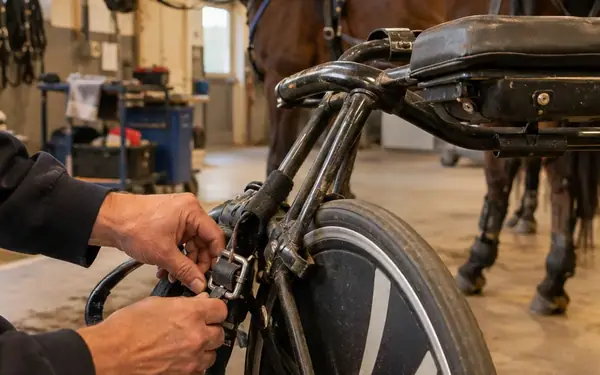
The physical mechanics of harness racing translate surprisingly well to jumping once redirected upward. Pulling a sulky at speed requires massive driving power from the stifles and hocks. When a rider teaches the horse to engage its abdominal wall instead of pushing forward against a breastplate, that horizontal propulsion converts directly into vertical push-off strength for show jumping verticals and cross-country banks.
Distinguishing Track Posture from True Conformation
Some observers look at a freshly retired racer and see a long loin, a steeper croup angle, or a hollow outline, concluding the horse lacks the geometry for a hunter course. In practice, evaluating a horse's condition and jumping potential means separating permanent skeletal traits from temporary, track-induced posture. Checkrein use and driving bits often leave a newly retired horse with an inverted lumbar spine and an underdeveloped thoracic sling. Mistaking checkrein-induced lumbar inversion and heavy driving-bit bracing for an inherent inability to bascule over a 2-foot-6-inch hunter oxer causes many trainers to overlook exceptional talent. Within an estimated 6 to 9 months of consistent flatwork and pole conditioning, developing a rounded topline and gluteal lift under saddle completely alters the horse's visual profile in the show ring.
Reschooling the Gait: Building a Balanced Three-Beat Canter
A horse conditioned to lean into a driving bit and pull from its shoulders operates on a simple biomechanical rule: pressure in the mouth means drive harder from the front end. Before a retrained Standardbred can jump an even hunter course, it must learn to relax its jaw, lift its back through the wither, and step actively underneath its center of gravity.
Early retraining protocols discarded draw reins and restrictive figure-eight nosebands after trainers found that heavy bit contact triggered the horse's track instinct to brace its jaw and drive harder from the shoulders. The modern retraining progression relies instead on unrestrained long-and-low stretching to shift weight backward onto the hind legs before ever asking for a canter transition.
Track Banking and Asymmetry
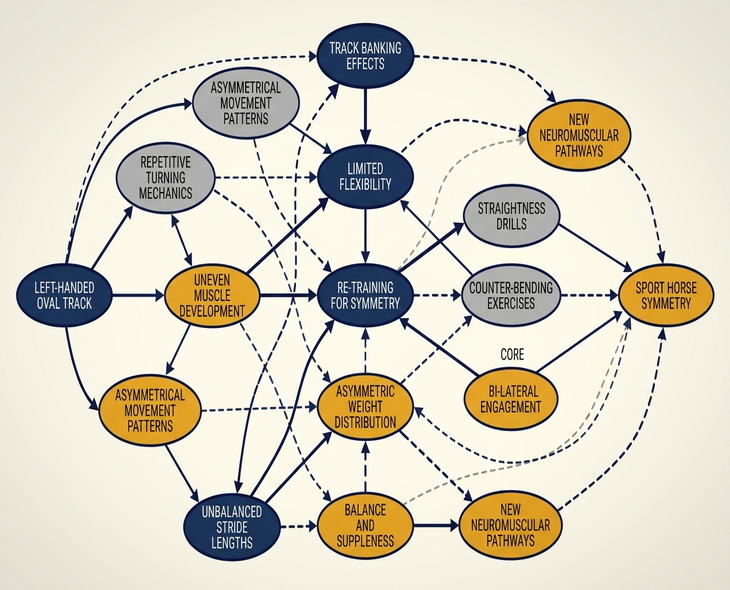
Horses that raced extensively on five-eighths-mile or half-mile tracks with steep banking often carry left-lead asymmetry and right-hind stifle stiffness that require bodywork release and symmetrical hill work before you attempt right-lead canter circles in a standard arena.
Both trotters and pacers benefit from a structured timeline that separates lateral or diagonal track muscle memory from a true, suspended three-beat canter:
- Weeks 1 to 8 (Unmounted and Mounted Suppling): Focus on lateral flexion, leg-yields along the rail, and long-and-low lunging over single rails to release tension in the lumbar spine.
- Weeks 8 to 12 (Cavalletti and First Departures): Introduce trot cavalletti spaced at 4 feet 3 inches to 4 feet 9 inches and raised 6 to 8 inches off the ground. Addressing a left-lead muscular bias from banked half-mile harness tracks often calls for diagonal cavalletti grids at a 4-foot-6-inch spacing to disrupt lateral pacing memory and encourage diagonal suspension. Initiate the first canter departures off the outer corner of a 20-meter circle or up a gradual outdoor incline.
- Months 4 to 6 (Lead Stabilization and Stride Adjustment): Once the horse balances softly on both leads without rushing, introduce small gymnastics and eventually ask the horse to lengthen and shorten its frame inside a standard 60-foot five-stride hunter line.
Why Paddock Exposure Creates a Steadfast Competition Partner
Consider the difference between two five-year-old horses arriving at a bustling multi-ring venue on a breezy Saturday morning. The green purpose-bred sport horse, raised on a quiet private farm, often grows tense at the sound of flapping tent canvas, golf carts, and loudspeaker announcements. The retired Standardbred stands quietly by the trailer on a loose buckle, chewing hay while a tractor drags the adjacent ring.
That calm demeanor is the product of intense early conditioning. Track education routinely begins at approximately 18 to 24 months of age, immersing young Standardbreds in a structured routine of commercial trailers, flapping harness clips, busy wash-stall traffic, and multi-horse warm-up lanes under stadium lights. By the time these horses enter retraining programs or start a second career under saddle, chaos is simply background noise.
For adult amateurs and junior riders, this mental resilience serves as a decisive safety advantage. Eventing instructors regularly point out the breed's rapid heart-rate recovery and absence of spooking when schooling across three-phase cross-country water complexes, open ditches, and timber drops up to 2 feet 11 inches. When a retrained Standardbred meets an unfamiliar brightly painted filler fence or a sunken road obstacle, its default response is to lock onto the question and figure out where to put its feet.
Evaluating Performance Over Pedigree at the In-Gate
Despite the breed's physical ability, a subtle ringside bias still surfaces at some open competitions. When a judge or ringside trainer spots a neck freeze-brand or notices a slightly higher head carriage during a downward trot transition, they sometimes anticipate a four-beat pace-canter or a flat jump before the horse even leaves the ground.
Fair judging strips away that visual prejudice by isolating the core directives of the scorecard. In the hunter ring, an objective evaluation distinguishes a suspended three-beat canter from a lateral four-beat gait during the first corner of an 8-fence course, then grades what actually unfolds: a uniform 12-foot hunter stride down the outside line, straightness of approach, a clean bascule over the center of each fence, and a relaxed poll with steady contact toward the out-gate. In dressage and eventing phases, willing submission and rhythmic cadence matter far more than breed registry papers or breed stereotypes.
You bring your bay gelding down to a walk outside the open hunter out-gate and lean forward to pat his damp neck right over the white numbers of his freeze-brand, listening as the loudspeaker crackles and calls your entry number at the top of the under-saddle and over-fences stake.