How DMRT3 Shapes a Standardbred’s Transition to Saddle
A Standardbred that paces when asked to canter presents a coordination problem with consequences for comfort and soundness. Treating that response as resistance can lead to stronger driving aids, a hollow back, and loading that strains the sacroiliac region. Retraining progresses when the rider builds balance around the horse’s inherited movement tendencies.
The central finding: the DMRT3 “Gait Keeper” mutation changes spinal coordination, helping horses sustain pace or fast trot through speeds that usually prompt canter. Its influence helps explain why accelerating a retired harness horse can produce more lateral movement while the requested canter remains elusive.
Early schooling therefore needs a clear order of priorities:
- Establish the baseline gait. Observe whether light tension brings out a lateral pace, a stepping gait, or a diagonal trot; use a genetic test when identifying AA, CA, or CC matters.
- Develop postural balance. Seek a steady rhythm, a supported trunk, and a neck that extends comfortably before requesting greater forward effort.
- Separate the canter cue from acceleration. Prepare the depart from a balanced walk or a sufficiently organized, collected trot.
These priorities give a second-career Standardbred a consistent task: carry the rider with an organized stride, then change gait without rushing.
The Spinal Coordination Behind Pace, Trot, and Canter
Riders familiar with horses that readily walk, trot, and canter may interpret cross-cantering or a stepping pace as simple weakness. That interpretation overlooks the networks that organize limb timing before strength enters the equation. Strength matters, but the horse must also coordinate the requested sequence.
The DMRT3 gene encodes a transcription factor, a protein that helps regulate other genes. It participates in the development of spinal interneurons, including a group called dI6 neurons. Connections within these networks help coordinate movement across the body’s midline and between the forelimbs and hindlimbs.
The Nature study identifying the DMRT3 nonsense mutation in horses describes a premature stop codon that truncates the protein and alters spinal coordination associated with pacing and high-speed trotting without a transition to canter.
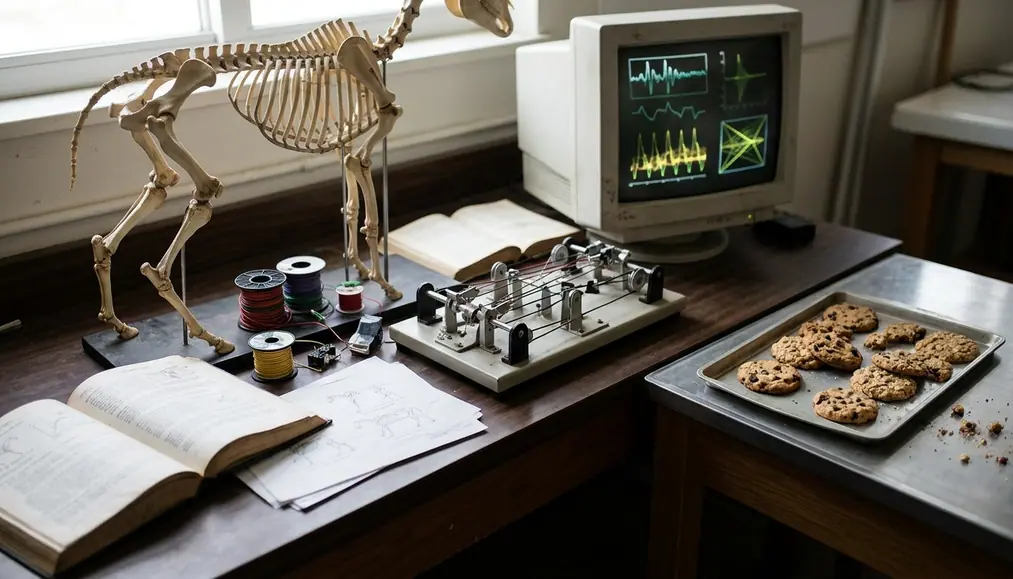
At trot, diagonal limb pairs move together. At pace, the limbs on the same side move together. Canter requires an asymmetric sequence with a diagonal pair within its three-beat rhythm. Moving between these patterns requires a reorganization of timing throughout the body.
For training, the useful distinction concerns gait selection at increasing speed. A horse carrying the mutation may maintain its established symmetrical gait as stride frequency rises. More speed therefore supplies an unreliable canter aid. A clearer transition begins with balance, a recognizable cue, and enough freedom through the trunk for the limb sequence to change.
What AA, CA, and CC Mean for Under-Saddle Assessment
Similar racing backgrounds can conceal different movement preferences. The genotype describes which DMRT3 alleles the horse carries: AA has two copies of the mutated A allele, CA has one, and CC has none. A genetic hair-root test establishes that distinction.
Movement assessment answers a separate question: which coordination pattern currently dominates under the conditions of schooling?
AA: assess lateral locking and the quality of the trot
AA occurs in pacers and many harness trotters. An AA horse may sustain an excellent diagonal trot, yet another may readily pace or amble when tension increases. The assessment should examine whether the ribcage becomes rigid, the hindquarters swing laterally, or the horse flattens through an attempted canter transition.
A lateral response calls for deliberate work on trunk mobility and balanced transitions. Genotype alone supplies no reason to discard a comfortable, regular trot already present.
CA: examine changes between relaxed and tense work
CA horses can express a mixture of diagonal and lateral tendencies. A horse may trot cleanly on a straight line, then slip into a stepping gait during a downward transition. That change identifies a useful schooling target: preserving the same organization as speed decreases and the rider changes the aids.
Visual assessment cannot reliably separate AA from CA when track conditioning, long toes, or sacroiliac soreness alters movement; a DNA test resolves the genotype question.
CC: develop carrying strength and clear transitions
CC horses lack this mutation and generally fit the conventional walk–trot–canter pattern more closely. Their retraining can emphasize carrying strength, steering, and recognition of ridden aids. Across all genotypes, the most useful baseline comes from watching the actual footfalls, trunk posture, and response to transitions.
Build Diagonal Rhythm Before Asking for Canter
When a Standardbred loses balance at trot, stronger pressure from both legs can intensify a familiar harness response: brace, widen, and accelerate. A productive sequence reduces that urgency and gives the horse a physical arrangement that supports a different response.
Organize the trot over ground poles
Begin with an even working trot on a broad curve. The rider should maintain a quiet contact and follow the movement without pushing for speed. Ground poles then provide a visible, repeatable task.
- Arrange four to five heavy wooden ground poles along the arc of a roughly 20-meter circle.
- Start with approximately 1.2 to 1.3 meters between poles along the intended track, adjusting the spacing to the horse’s comfortable working stride.
- Approach in a regular diagonal trot, allowing the neck to reach forward as the horse negotiates the poles.
- Return to uncomplicated flatwork while the rhythm remains settled, then repeat with the same approach.
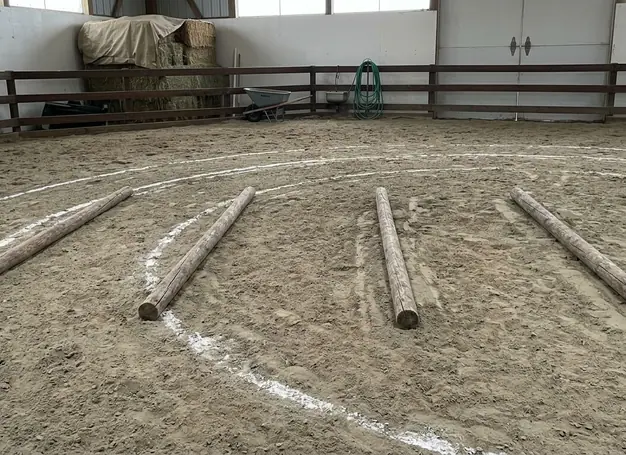
The poles encourage limb clearance and movement through the back. The useful response is a steadier trunk, freer articulation through the lumbosacral region, and a neck carried without bracing. Rushing through the exercise calls for a quieter approach and simpler work.
Make the canter depart a distinct task
Establish a brisk, laterally supple walk before preparing a depart through a 15-meter corner. Near its apex, the rider places the outside leg behind the girth and allows the inside rein forward as the inside foreleg lifts. This separates the request from the escalating trot speed associated with harness work.
Reward a clear three-beat response promptly. Early success lies in the organized strike-off and the horse’s ability to remain soft through the transition.
At the next corner, the Standardbred keeps its walk rhythm. The rider gives the distinct outside-leg cue; the horse lifts through the withers and steps into canter. After a few balanced strides, the pair returns quietly to walk.